
Gertrude and Josephine Schnitzer
I began researching the lives of my great grandmother and grandmother in 2009 and launched the website josephine.aoart.co.uk setting out what I knew about their lives and the unsolved mysteries. To summarise:
- Gertrude Schnitzer gave birth to a daughter, Emma Josephine, on Tuesday 10th April 1900 at 31 Sturry Street, Poplar, a charitable home in the East End of London to assist young unmarried mothers and their babies.
- Gertrude, a Romanian born in Bucharest, was a teenager of uncertain age at the time of Josephine's birth. Her date of birth and age given in subsequent censuses was never consistent.
- No other member of the Schnitzer family could be found searching on genealogy websites.
- It was a mystery how Gertrude came to be in London, pregnant and apparently alone.
- By the time of the 1901 Census, 31st March, mother and daughter were separated and Josephine, less than 1 year old, was a boarder in a household in Halstead - 7 Well Yard, a three roomed cottage.
- Some time between 1901 and 1903 Josephine made the extraordinary transition to Huntsham Court, a country estate in Devon, where she lived until early adulthood and marriage in 1923. In the 1911 Census Huntsham Court is recorded as having 38 rooms and 10 servants.
- Hugh Acland Troyte inherited Huntsham Court in 1896 at the age of 25 and three years later, on 3rd June 1899, married Helen Jessie Chapman (known as Jessie); he was 28 and she was 51 years old.
- How and why did Josephine make the move to Huntsham Court?
- Who was Josephine's father? My family's long-held theory explaining the circumstances of Josephine's move to Huntsham Court was that Hugh Acland Troyte must have been her father.
On completing the website I was convinced I had reached a dead-end and there were no more answers to be found. However, after a renewed period of searches and investigation in 2022/23 I have been proved wrong! I have uncovered some fascinating information and solved some of the mysteries ... and also raised new questions and openings for further research.
Further research and new discoveries
Gertrude's brother? [pub: 20.05.2024]


New discoveries
I have unearthed new information and formed new theories as a result of:
- DNA tests with 23andme and Ancestry in 2022
- Release of the 1921 Census (January 2022)
- Records in The National Archives, Kew
- A book by the Reverend A Hastings Kelk
- The Huntsham archives
- Release of 1939 Register (November 2015)
- Newspaper archives
The wonders of DNA - a breakthrough
My reason for taking the DNA tests was the hope that I would make new connections with relatives who may have further information to share about our mutual ancestry. That has happened on my mother's side of the family and I have been in communication with newly discovered close cousins in Canada, New Zealand and the UK.
I did not anticipate that the DNA ethnicity results would be of any great interest or relevance to my research. However, analysis and interpretation of those results have proved otherwise, my DNA results have played a key role in providing answers about Josephine's paternity. I can state categorically that Hugh Acland Troyte could not have been Josephine's biological father. The doubts concerning how Hugh could possibly have encountered Gertrude as a teenager were valid. Josephine's presence at Huntsham Court was as a consequence of happenstance. Fate determined a sequence of events and encounters that were pivotal in the lives of Gertrude and Josephine. Some of these will remain unknown forever, some are described below following the section on DNA.
How DNA has revealed the truth about Josephine's father
The key factors in the DNA test results which support the above conclusion are:
- The degree of Ashkenazi Jewish in my ethnicity estimate - 42%.
- My DNA matches.
- One of my X chromosomes being 100% Jewish.
A rational assumption has been made based upon Hugh Acland Troyte's known ancestry - he was not Jewish.
1. Ashkenazi Jewish ethnicity
I have Jewish ancestry on both sides of the family. As the following breakdown from Ancestry shows, my 42% is mostly from my father's side i.e. 31%. The 11% from my mother's side is from her grandfather Jean Jacques Stanislas Schwob - see hetty.aoart.co.uk for the full story. Ancestry state that the estimate is 42% but the range can be from 38-46%.

Each parent passes on 50% of their DNA but that does not necessarily translate to ethnicity inheritance being passed down in half measures. DNA segments associated with a particular ethnicity can vary between siblings for instance. But the estimate of Jewish inheritance can be used to support my conclusion concerning Josephine's parentage. The logic of the argument is as follows: looking at my father's side, it can safely be assumed that there is no Jewish heritage from his father Frank May Lunn. The Jewish DNA is being passed down from his mother Josephine and grandmother Gertrude. It is highly probable that for me to have inherited an estimated 31% Jewish ethnicity on the paternal side Gertrude was 100% Jewish and so was Josephine's father, meaning of course that Josephine was 100% Jewish. My father was therefore in the probable range of 46-54% Jewish, and interestingly because the Jewish religion practices matrilineal descent would have been considered Jewish by Jewish Law.
For further information on DNA and Jewish ethnicity see articles on ancestry.co.uk and 23andme.com.
2. DNA Matches
The close matches on Ancestry include:
- Susan, 1st cousin on my father's side (we share grandparents, Frank Lunn and Josephine Morris) - 12% shared DNA
- Carolyn, 2nd cousin on my mother's side (we share great grandparents, Jean Jacques Schwob and Hetty Marshall) - 4% shared DNA
- Pat, 2nd cousin 1x removed on my mother's side (we share Pat's great grandparents, my great great grandparents, Patrick Marshall and Catherine Grady) - 2% shared DNA
- Yaakov Bendoim, the person of greatest interest, a match on my father's side - 4% shared DNA
Yaakov Bendoim is a shared match with my cousin Susan proving conclusively that he is a match on my father's side. Yaakov Bendoim is 99% Ashkenazi Jew and our most likely relationship is half first cousin once removed (i.e. that we share Yaakov's grandfather). Less likely, half second cousin. Whatever the precise relationship between Yaakov Bendoim and me, he must be directly descended from the unknown man who was Josephine's father, who himself must have been an Ashkenazi Jew.

As of April 2023 I am hoping and waiting for a response from Yaakov Bendoim to the messages I sent via the Ancestry messaging service and a Facebook page I believe belongs to the same person and also a letter I posted to an address that I hope is his in Florida. I think it is highly likely that he will have no knowledge of Gertrude and Josephine and be unaware that there is another branch to his family history.
3. X chromosome
- The 23rd pair of chromosomes are the 'sex chromosomes' - females have 2 x X and males have 1 x X and 1 x Y.
- Males receive their single X chromosome from their mother and their Y from their father.
- Females receive an X from each parent. The X from their father is an exact copy of his own X.
- The X chromosome passed on from mother to child is typically a combination of her two X chromosomes - this is called recombination.
The graphic representation of my X chromosomes looks like this:

The top one is 100% British/Irish and the bottom one is 100% Ashkenazi Jewish. The 100% Jewish chromosome could not have been inherited from my mother because she did not have any inheritance from 100% Jewish parents. It was passed to me from my father and he would have inherited that directly from his mother, Josephine.
DNA evidence
These three key findings from my DNA analysis indicate that Josephine was of 100% Jewish ancestry and that Hugh Acland Troyte could not have been her father. Josephine's father is almost certainly the ancestor I share with Yaakov Bendoim (who appears to have origins in Moldova, once part of Romania).
Found! Gertrude in 1921
The DNA result inspired another round of research and digging into the archives. Having previously failed to find Gertrude in the 1921 Census - a search for nurse, female, born Romania, 1885 ± 5 yrs came up trumps! Maybe the search algorithm or indexation has improved, or maybe I didn't try that particular set of search terms. If I had always included the surname Morris failure was inevitable because her surname has been badly mis-transcribed as Wores.

Gertrude was categorised as a servant, working as a sick nurse at the home of solicitor Joseph Gregory (age 33), his wife Alice (age 29) and a visitor Clara Hough (age 34) at 217 Upper Chorlton Road, Old Trafford. Gertrude's entry is Anna Maria Gertrude Morris, age 35, single, Rumania Bucharest, Resident naturalised British Subject. Her age would suggest a year of birth of 1886 making her just 13 years old at the time of Josephine's birth, far younger than we had ever considered.


I was intrigued by the mention of Gertrude being a Naturalised British Subject ... more searching required, this time the catalogues of the National Archives.
Moricean, Annica Gertrude Maria (known as Annica ...
The index record I found by an online search of the National Archives looked very promising, although the surname Moricean was a little puzzling:

Gertrudge had long ago turned her back on her birth name Schnitzer and for obvious reasons, in 1917, would not have wanted to resurrect a German sounding name in order to apply to become a British Subject. Did she invent Moriçean as a Romanian version of her newly adopted surname Morris?
I ordered a digital version of the document and on my initial reading through the papers were out of order. The first hint that this was definitely Gertrude was the mention of her being a nurse and soon afterwards the name 'Troyte' cropped up as a referee - confirmation that this was Gertrude's application to become a naturalised British citizen. The naturalisation application and associated documentation were 'closed' until 2017 due to the 100 year privacy rule. This fascinating piece of family history has been lying in wait for 6 years.
The documents can be viewed on a separate page - Naturalization application 315781 - and are best viewed on a laptop or desktop. Interspersed in the application, letters and other documents, in hide/show format, I have added observations, historical context and additional information. Below I have set out the principal revelations and insights gained from Gertrude's naturalisation application.
Naturalization application 315781 - Annica Gertrude Maria Moriçean
New revelations and insights
Gertrude's date of birth and age at Josephine's birth

Gertrude's year of birth has never been known for certain*. Throughout her life it varied in census records and the death register entry meant her year of birth would have been 1881 and age 19 years at the time of Josephine's birth. Gertrude's date of birth declared on the naturalisation application is 15th June 1886. I am as certain as it is possible to be that this is accurate, Gertrude would have been ill advised to lie about facts in sworn statements in the application; she would have had no way of knowing if her date of birth was recorded elsewhere and able to be checked as part of the very detailed and thorough attention given to each part of the application process. Josephine was born on 10th April 1900 meaning that Gertrude was 13 years old at the time and just a month or so past her 13th birthday when she became pregnant. This raises so many questions about the circumstances of her pregnancy. Why was she not supported by her family? Could a close family member have been involved? Was she raped? Was she disowned by her family?
The evidence that she became pregnant at such a very young age heightens the poignancy of Gertrude's desperate circumstances, little more than a child, alone in a foreign country with no friends or family. Through her life she was burdened with guilt and shame as a result of what had happened to her as a girl. She was blameless - a helpless victim and it would appear that she was cast out of her family, her country and arrived in London at the mercy of charitable organisations and the philanthropy of individuals.
* Discrepancies in Gertrude's date of birth
Until now it has always been difficult to pinpoint Gertrude's date of birth as there is a so much inconsistency between the records - censuses, the 1939 Register and the deaths register. In the 1939 Register and in a letter written to her grandson John Lunn on 4th May 1965 Gertrude's day and month of birth are 15th June. The year of her birth either given or calculated from her declared age varied.
| SOURCE | AGE/DOB DECLARED | CALCULATED DOB |
|---|---|---|
| 1901 Census, 31st March | Age 18 | 15th June 1882 |
| 1911 Census, 2nd April | Age 26 | 15th June 1884 |
| 1921 Census, 19th June | Age 35 0 months | 15th June 1886 |
| 1939 Register, 29th September | 15th June 1882 | 15th June 1882 |
| Death registration | Age 83, d.9th May 1965 | 15th June 1881 |
Based on these records Gertrude's age at the time of Josephine's birth could have been anything from a couple of months away from being 14 years old, based on the 1921 Census to coming up to 19 years old, based on the death registration.
Gertrude's name

In the application full name is given as Annica Gertrude Maria Moriçean - known as Morris. We know from the 1901 Census that Gertrude was Gertrude Schnitzer and from Josephine's birth records and 1901 Census that she was also Schnitzer. By 1911 their surname had changed to Morris. There is no reason to doubt that Schnitzer was Gertrude's true family name. There was a notion in family lore that Morris was chosen as a replacement surname because Gertrude had a brother with that name. It seems likely that for the purposes of the naturalisation application Moriçean was reverse engineered from the adopted name Morris. There was no need to complicate her application by referring to Schnitzer, a German sounding name, at a time when Germans were classified as enemy aliens and subject to restrictions or internment. Morris to Moriçean sounds a bit Romanian, although a cursory look at the Wikipedia entry for the Romanian alphabet shows that the cedilla is only used with the letters S and T. And a search of all records in Ancestry for 'Moricean' results in just 89 records. None of these are connected to Romania or Romanians. Conclusion: Moriçean was an invention.
Gertrude's parents

Bearing in mind the invention of Moriçean how likely is it that Gertrude's parents were George & Peppina Moriçean? Peppina is a shortened version of Guiseppina, which is the Italian version of Josephine. It is possible that the name Peppina was the result of some more reverse engineering, starting with the middle name given to her daughter Emily Josephine.
There are three further references to Gertrude's parents in the documents:
- In the section where she states the grounds for seeking to become a British Subject Gertrude writes:
as my parents are dead & I have no home in Roumania, I have no desire to return there.
- In Gertrude's letter of 14th July 1916 she writes about her difficulties in registering with the police as required of foreign nationals at that time:
as my parents died in my childhood I am unable to give details that the Police stations require before they can grant me an identity book.
- Gertrude was interviewed by a police sergeant from the CID, Special Branch, New Scotland Yard as part of the enquiries into her suitability to be granted citizenship. Within the report is a reference to her parents:
Memorialist states that she was born at Bucharest, Roumania on the 15th June 1886, of Roumanian parents. She has no documents in proof of this, as she says she left her parents when she was about 13 years of age, and came to England with some friends. She cannot remember the name of these friends, nor can she say where they live at the present time.
There is inconsistency between Gertrude's written statements that her parents died during her childhood and what she said to the police sergeant when being interviewed. Were her parents dead? Was she orphaned as a child? The truth is most likely to be what Gertrude said in the somewhat pressurised circumstances of a police interview; as a young teenage girl she left Romania, probably involuntarily, because she was pregnant. Naturally, she didn't want to reveal this private and sensitive matter so she invented the story about coming to England with friends. I have no knowledge of the customs and social practices in late nineteenth century Romania and how being Jewish may have impacted a family facing a teenage pregnancy. With Gertrude's date of birth now confirmed a Romanian based genealogist may be able to track down some birth records to reveal further information about Gertrude's parents.
There is still a mystery surrounding the circumstances and practicalities of Gertrude's passage from Bucharest to London. I have a theory for how this transition came about - it is discussed below under the heading From Bucharest to Sturry Street.
Support for Gertrude's application for naturalisation
Gertrude's naturalisation application had the backing of the following:
- Hugh Acland Troyte - owner of the Huntsham Estate and de facto adoptive father to Josephine
- Jessie Acland Troyte - Hugh's wife, sister of Hugh and Cecil Chapman and de facto adoptive mother to Josephine
- Reverend Hugh Boswell Chapman - Chaplain of the Royal Chapel of the Savoy
- Cecil Maurice Chapman - Metropolitan Magistrate, Tower Bridge Police Court
- Arthur Whitehead - JP for the City of New Sarum
- Herbert Barclay - Clerk in Holy Orders, Rector Allington and Boscombe
- Lilian Cowell - secretary to Hugh Chapman


These pillars of society contributed as witnesses and referees making sworn declarations which would have been hugely advantageous to Gertrude's application, particularly since she had no passport or proof of her Romanian origins. Entries in the minutes made in May 1917 noted she has good referees and she is very well recommended.
This salutary tale of a Russian immigrant, Harry Morris b.Moros, reiterates the significance of the support that Gertrude had with her own application:
Harry, after moving to his wife’s hometown of Manchester, was called up for service in July 1918. Thanks to help from Leon Locker, one of the founding members of the Manchester branch of the ‘Foreign Jews Protection Committee’, he was able to prove he was over the age of 41 in 1917, and therefore his calling up notice was cancelled. It was about this time that his Russian passport was lost, for he apparently deposited it in 1919 at the Liverpool Russian consulate. After that institution closed, it was not possible to trace his passport, and this is what meant Harry was not able to become a naturalised British citizen.
Gertrude and the Chapmans - two worlds collide
Hugh Chapman - residence referee
In the Metropolitan Police CID report of 20th March 1917 the testimony of Hugh Chapman, as Gertrude's residence referee, is recorded by the interviewing police sergeant:
Residence Referee Hugh B Chapman, Chaplain of Royal Chapel of Savoy, is a respectable responsible person, householder and natural-born British subject, and speaks of Memorialist as a respectable person. He states that he has known Applicant for about sixteen years, having first made her acquaintance at the Royal Chapel of Savoy where she attended as a child. When she was about 17 years of age he obtained a post for her at the Mildmay Cottage Mission Hosptial, where she underwent training for a nurse. The Reverend gentleman states that since she left the above Hospital he has kept in close touch with her, and says he has no hesitation whatever in vouching for her loyalty to the British Empire.
Examining the facts, Hugh Chapman's claim that he first met Gertrude at the Savoy Chapel seems a little unlikely. The year of their first encounter, "about sixteen years" ago, would be 1901 when Gertrude was age 14 and living with the Minton family at Collingham Road, Kensington some 4 miles from the Savoy Chapel, classified as a 'nurse'. At that time Hugh was Rector of St Luke's, Camberwell living at 177 Camden Grove North, Camberwell and several years away from his appointment as Chaplain of the Savoy Chapel, in November 1908. It isn't impossible but it seems unlikely that the two would have met at the Chapel Royal in The Strand. It is most likely that the connection between Hugh and Gertrude came about through 31 Sturry Street, the charitable organisation with a mission "to assist young women of previous good character to a new start in life, especially those who, not necessarily depraved, are about to become mothers for the first time. These are confined at the home and then helped into a position to support their little ones." Throughout the application there is great emphasis on respectability and loyalty, and as well as hiding Gertrude's German-sounding surname, Schnitzer, it would have been considered expedient not to mention her past pregnancy and the truth behind the origins of the acquaintance. Sadly, concealment of the truth, as a result of social judgement and the consequent sense of shame and maybe even guilt, continued to be the pattern for the rest of Gertrude's and Josephine's lives.
Whatever the exact circumstances of Gertrude making the acquaintance of Hugh Chapman it was the most fortuitious of encounters and a critical juncture in her young life as well as for baby Josephine. An item printed in the Daily Herald following Hugh's death in 1933 captures a great deal about his singular mission as a clergyman and as a philanthropist.


Jessie Acland Troyte née Chapman - personal referee
Further information can be gleaned from a report submitted by the Chief Constable's Office, Devon Constabulary, Exeter on 21st April 1917. The report was to endorse Jessie's integrity as a referee and her declaration made in May 1916 supporting Gertrude's application and included some additional information from an interview with Jessie:
Mrs Troyte has known the applicant for the past 16 years, and first became acquainted with her through her (Mrs Troyte's) brother in London, where she often meets Moriçean in the hospitals. About 13 years ago the applicant was a guest of Mrs Troyte's at Huntsham Court, Bampton, Devon for a period of three months.
The fact that Gertrude was a guest at Huntsham Court for 3 months is fascinating. The visit would have occurred in 1903 when Gertrude was 16/17 years old and Josephine 3 years. The purpose of Gertrude's extended stay with the Acland Troytes may well have been in conjunction with Josephine's arrival at Huntsham Court. Gertrude may have been there to help Josephine settle in to her new home, or just as likely, it could have been to give the now more mature Gertrude the opportunity to be re-acquainted with her daughter and decide whether to make a life together? We know that Josephine was separated from Gertrude at the time of the 1901 Census but it is difficult to imagine what happened to mother and daughter throughout the period June 1900 to Josephine's arrival at Huntsham Court in 1903 and how much contact there was between the two - they were living apart but maybe maintaining some degree of contact. It is worth remembering that a lone 13/14 year old girl in a strange country would have been ill equipped to look after herself let alone a baby. And consider this ... would that young girl in her early teens have wanted the responsibility of a baby?
We also learn a new piece of information concerning Gertrude's whereabouts in her early years in England from the report of her interview with the CID:
When she first came to England she entered an English family as childrens governess, and remained there until age of seventeen, when with the assistance of the Rev. Hugh B Chapman, she obtained a post at the Mildmay Cottage Mission Hospital. At the age of 21 she left this hospital and took up private work, and has been thus engaged up to the present time.
The 1901 Census captures a snapshot of the English family referred to - the Mintons of 10 Collingham Road, South Kensington. Harry Minton, age 39 was a schoolmaster, working at home, married to 29 year old Ethel and with three children - Frances 6, Robert 2 and Geoffrey 10 months. There were 6 servants in the household, including Gertrude Schnitzer, a nurse, age recorded as 18 in the census (she was actually 14 years old). It isn't clear how Gertrude obtained her position with the Mintons - via Hugh Chapman or more likely the charitable institution of Sturry Street where Josephine was born, its mission being to assist pregnant young women of previous good character to a new start in life ... [and] helped into a position to support their little ones. What a condundrum Gertrude and Josephine must have presented to those trying to assist at their time of great need. How to enable a 13/14 year old girl to support a baby and make their way in a strange new country?
What is clear is that after about 3-4 years in the Minton household Gertrude, age 17, was helped by Hugh Chapman into a position at the Mildmay Cottage Mission Hospital where she received training as a maternity nurse. 1903 was a pivotal year - seeing the arrival of Josephine at Huntsham Court with Gertrude staying for 3 months and then taking up a position at the Mildmay Hospital.
Gertrude's places of residence and employment
Gertrude was required to list her places of residence for the last 8 years and no wonder she made some mistakes - there are 14 addresses. In the 17 months from January 1915 to May 1916 she moved 7 times. This section reveals that during this period Gertrude led an itinerant and unsettled life. She was mostly resident in London, but also in Burton on Trent, Salisbury, Shanklin, Hindhead and Watford.
The Certificate of Naturalization
Finally on 20th August 1917 the certificate of naturalisation was issued by the Home Office, receipt of Gertrude's application having been date stamped 15th June 1916.


From Bucharest to Sturry Street
That Gertrude, a 13 year old Romanian, born in Bucharest, should give birth to Josephine at Sturry Street in the East End of London in 1900 with no other family members in evidence has always been a mystery. It now seems most likely that she became pregnant in Bucharest by the Romanian Jewish ancestor that I share with Yaakov Bendoim. How did such a young girl from Bucharest end up in London?
A clue hiding in plain sight for nearly 60 years
Around 1965 Gertrude gave my sister and I a book containing pressed flowers. I used to love looking through it as a young girl but hadn't given it a second thought for decades. However, the book has what might be a clue to the mystery of how Josephine came to London ... the publisher. "Printed at the Office of the London Society for Promoting Christianity Amongst the Jews." The Society still exists today - known as "Church's Ministry Among Jewish People" or the CMJ.
The London Society for Promoting Christianity Amongst the Jews
More commonly known as The London Jews Society (LJS), the society's work began in the early nineteenth century among the poor Jewish immigrants in the East End of London. The centre of the LJS operations was built on a five acre site in Bethnal Green. The site was named Palestine Place and consisted of separate schools for boys and girls, a Hebrew missionary training college, the Episcopal Jews' Chapel and a "house of industry" which provided work for converted Jews, mainly printing books and pamphlets. The society proceeded to build hospitals and schools in Israel and mission stations across Europe and the Middle East - wherever there was a Jewish community.
A lengthy history of the society was written by Reverend W T Gidney covering the 100 years from the Society's beginning in 1809 - available as a PDF - The History of the London Society for Promoting Christianity Amongst the Jews. A short extract from page 602 will give some insight into the Society's activities and commitment to their cause.
The Rev. J.H. Adeney has carried on his zealous and indefatigable work in Roumania throughout the Period, assisted by the Rev. H. Zimmermann since 1905, and also by three or four colporteurs. The century opened with a useful Conference at Bucharest of Christian workers. Colportage has continued to be a great feature of the mission, being carried on from Bucharest, Bistritz, Galatz, and Jassy. Many towns are visited each year, and thousands of Christian publications circulated. The mission services, held every Sunday at Bucharest, have been largely attended; and the recent opening of a new hall, in memory of Mrs. Adeney, has afforded increased facilities for evangelizing work.
And a summary of a Romanian publication about the LJS:
Active in Bucharest since 1842, the LSPCJ had permanently sent missionaries, until 1941, when it ended all operations in Romania. British missionaries carried out an extremely complex activity. They organized evangelistic meetings and intensively visited Jews in their neighborhoods, in shops, restaurants, even in synagogues. They distributed Christian bibles and literature in various languages, including Hebrew, Yiddish and Romanian, having organized a vast network of press distribution. Of particular importance was their involvement in education. Overlooked, so far, by historiography, the school founded by the Mission in 1848 was the first elementary school for Jewish children in Bucharest.
The following item in The Western Times on 9th May 1903 gives an indication of the strength and breadth of the LJS's activities.

Is it possible that the LJS assisted Gertrude?
Although Palestine Place closed in 1895 at the end of the lease it seems feasible that the society could have been instrumental in assisting Gertrude to come to London's East End having had the centre of their operations in Bethnal Green for so many years, just 2 miles away from Sturry Street, Poplar. Maybe Gertrude had already been a subject of the missionary work in Bucharest. From our knowledge of Gertrude all the indications were that she was a devout Christian and churchgoer - a convert.


Found! Another photo of Josephine at Huntsham
There is a very precious and iconic photograph of Josephine at Huntsham Court as a 3½ year old. She is sitting, barefoot, on stone steps leading to a side door with a large, benign looking spaniel lying and leaning up against her. Josephine looks happy and smiling - it is a lovely picture and one that she kept her whole life. On the reverse written by Jessie Acland Troyte - "Bratto" 3½ Huntsham Court Devon "Sammy" a great friend

Reminded of a visit to Huntsham in 2004 and the kind hospitality of Lindsay and David Wall of the Huntsham Society I looked at the Society's website and the large online archive of photographs now available. Clicking through the album of Huntsham Court photos I stopped and stared ... at a familiar figure - Sammy the dog. There he was sitting on the lawn looking obligingly at the camera along with a family group sitting in comfortable chairs around a picnic table, under the dappled shade of two mature trees, a croquet hoop visible in the foreground.

Looking more carefully the identity of those people began to coalesce ... is that Josephine? Could it be her? Was the photograph taken on the same day as the photograph of Josephine sitting on the steps with Sammy? At first glance the child looks like a boy ... but Josephine's hair was cropped short and the child is wearing a loose white garment, just like the other photograph of Josephine. The woman is likely to be one of two possibilities ... Hugh's widowed mother, Katherine or Jessie Acland Troyte. They would be aged 57 and 55 years old respectively at the time of the photograph, 1903. The only other photograph of Jessie is from a later date, a sideview of her in the garden of Littlecourt her home from c.1919. Any comparison that can be made between the two photographs does not rule out the strong possibility that the woman in the photograph is Jessie - my assumption is that it is her. Josephine is sitting on what is most likely to be Hugh Acland Troyte's knee who would have been age 32. The older man could well be Philip Story (age 66) who lived at Huntsham Court, Jessie's widowed brother-in-law. There is an empty chair ... the photographer? It could have been Vera Story, Philip's daughter, Jessie's niece who also lived at Huntsham Court. Vera may well have taken the other photograph of Josephine and Sammy sitting on the steps outside the library.


Who is this man?
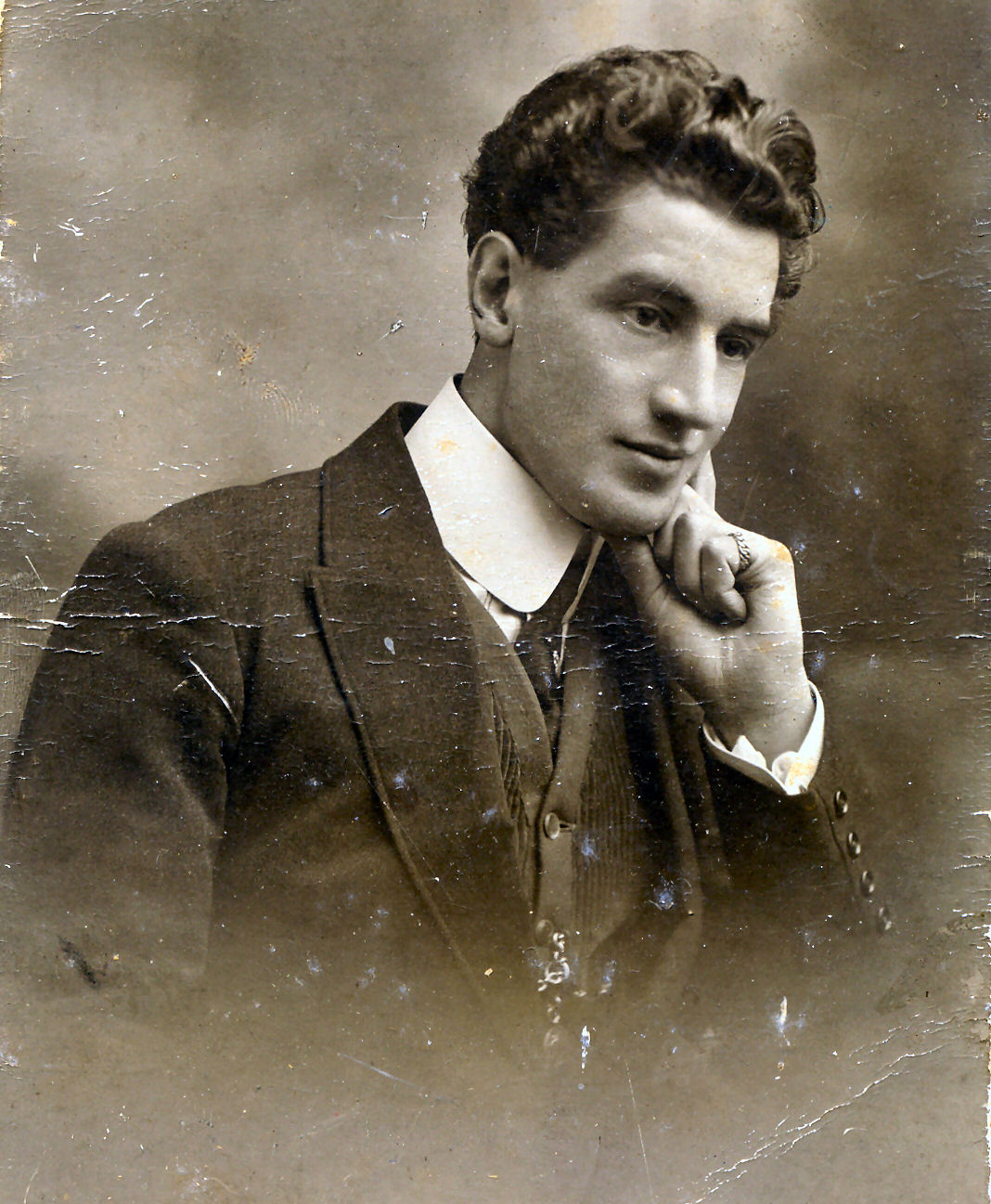
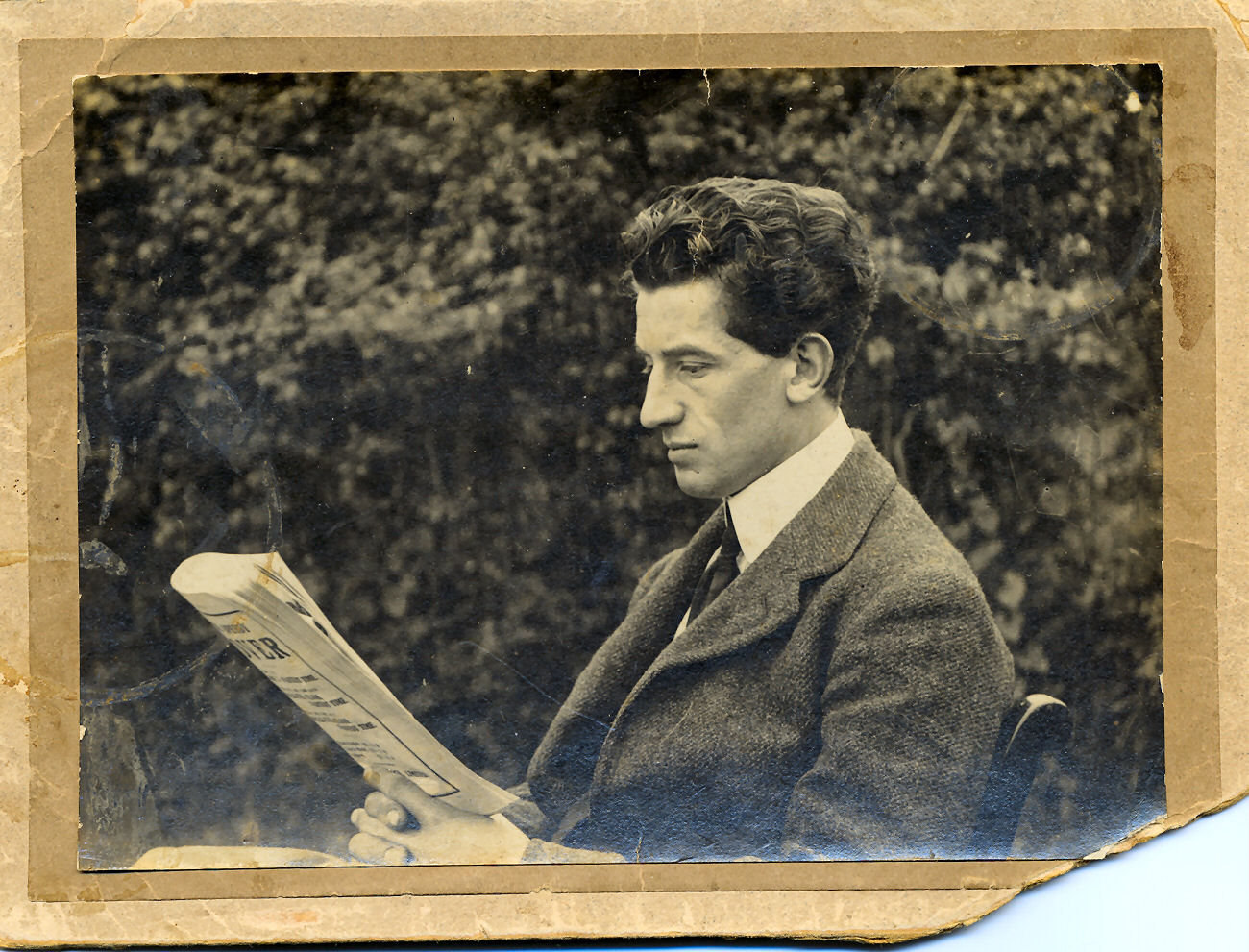


More to come ...
During the course of this second phase of research into the life stories of Gertrude and Josephine I have uncovered a large amount of interesting information which requires sorting and writing up:
- Life at Huntsham Court - Hugh Acland Troyte's coming of age
- Hugh Acland Troyte's marriage (age 28) to Jessie Chapman (age 51)
- 1908 - a year in the life of Hugh Acland Troyte
- A who's who of Josephine's Huntsham family
- Frank Lunn and Josephine Morris in 1921
- Reverend Hugh Boswell Chapman
- Gertrude and the suffragettes
- Josephine's album
- The Mildmay Mission Cottage Hospital where Gertrude worked for 4 years
- Hugh Chapman a victim of fraud and Herbert Acland Troyte's divorce - possible crossover connection to my mother's side of the family
- Jessie Acland Troyte and the enemy alien
- Jessie Acland Troyte's will
Further research
- How did Gertrude acquire her house in Cheltenham? Some time between 1921 and 1938 she became the owner of Yorklands, 87 St George's Road, Cheltenham.
- Evangelical Anglican missionaries and the London Jews Society: Palestine Place at Bethnal Green and related developments, 1813–1895. Curtis, R. Jewish Historical Studies, 2018, 50 (1), 5, pp. 69-100. DOI: https://doi.org/:10.14324/111.444.jhs.2018v50.004
- London Society for Promoting Christianity Amongst the Jews - archive.
- jwa.org - Romania, Women and Jewish Education
- Jewish Genealogy in Romanian Moldova
- findmypast.co.uk - 1911 Census
- whodoyouthinkyouaremagazine.com - article on DNA test results
- facebook.com/yakov.bendoim/friends - Yakov Bendoim - key DNA relative
- romania.jewishgen.org
- Huntsham Society - photographs of Huntsham Court
- National Archives - records on pupils at the Roan Foundation school
- British Jews in the First World War - Alien Restrictions Act
- Priscilla Wakefield
- Mildmay Cottage Mission Hospital
- Mildmay Mission to the Jews
- Medical Missions to the Jews
- romaniangenealogy.com - advice on Romanian genealogy research
- National Archives of Romania website
Useful websites
- jewishvirtuallibrary.org
- jwa.org - Romania, Women and Jewish Education
- reebmd.org.uk - search for birth, deaths, marriages